
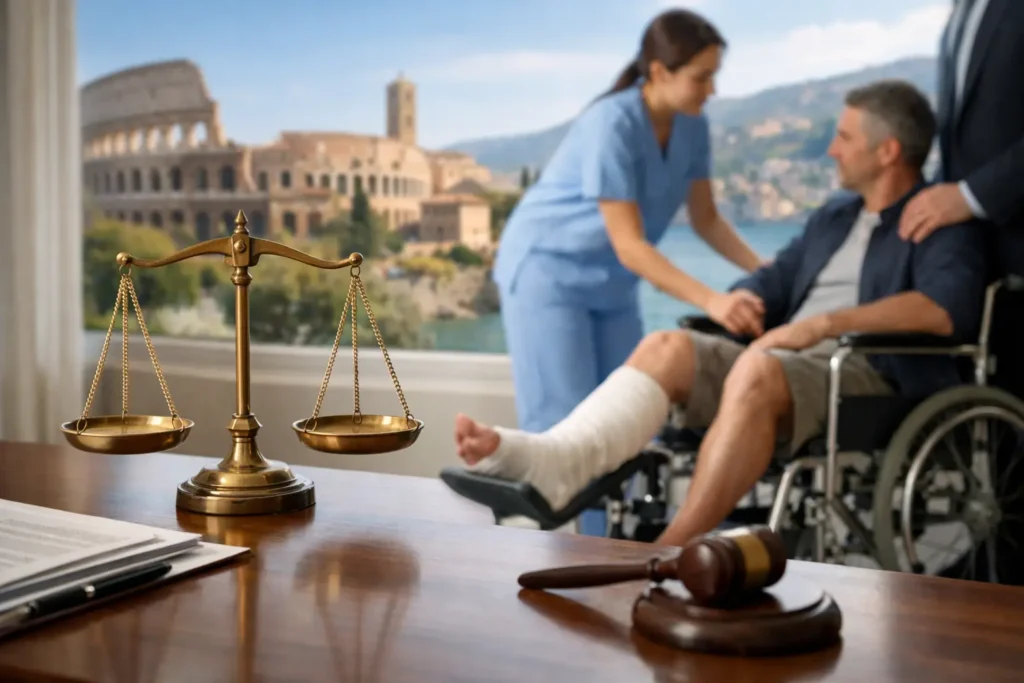
An accident in Italy can turn a normal trip, work assignment, or family visit into a legal and medical problem overnight. If you are dealing with a personal injury claim Italy matter, the first question is usually not legal theory. It is practical – who pays for the damage, what evidence matters, how long will this take, and what should you do now to protect your position.
That urgency is justified. Injury claims in Italy depend heavily on documentation, timing, and the way liability is framed from the start. A case that looks straightforward on day one can become harder if medical records are incomplete, witness details are missing, or the insurer controls the narrative before you have proper representation.
How a personal injury claim in Italy usually works
In Italy, personal injury claims often begin outside the courtroom. The injured party, through counsel, presents the facts, the legal basis of liability, and the damages suffered to the responsible party or its insurer. That can involve a road traffic accident, a slip and fall, a workplace injury, medical negligence, unsafe premises, or harm caused by defective conditions or third-party conduct.
Many claims are negotiated before trial, but that does not mean the early stage is informal. The opposite is true. The strength of the opening claim depends on evidence gathered immediately after the incident, the quality of the medical assessment, and a clear calculation of damages. If those pieces are weak, settlement discussions tend to follow that weakness.
Italy also distinguishes between different types of recoverable harm. The claim may include direct financial losses, but it can also involve non-economic injury, including physical and psychological consequences. The exact value depends on severity, duration, permanent effects, and how the injury changed daily life and work capacity.
What must be proven in a personal injury claim Italy case
Every case turns on proof. In broad terms, you need to establish that a person, business, institution, or insurer is legally responsible, that you suffered actual damage, and that the damage was caused by the incident in question.
That sounds simple, but the disputed issue is often causation. For example, an insurer may accept that an accident happened but challenge whether all of your symptoms came from that event. In a medical malpractice case, the hospital may argue that the outcome was a known complication rather than negligence. In a premises liability matter, the property holder may claim the hazard was obvious or that your conduct broke the chain of responsibility.
This is why records matter so much. Emergency treatment records, follow-up reports, imaging, photographs, witness statements, police reports, receipts, employment records, and expert evaluations all help establish not just that you were injured, but how and why.
The evidence that often decides the case
In cross-border matters, clients are often surprised by how much value turns on a few early documents. If you were hurt in Italy, preserve everything connected to the event. That includes scene photos, names of witnesses, transportation records, discharge papers, prescriptions, invoices, and written communications with insurers or property owners.
Medical evidence deserves special attention. A gap in treatment may be used to argue that the injury was minor or unrelated. Consistent follow-up, clear reporting of symptoms, and specialist evaluations can make a major difference, especially where long-term impairment is involved.
There is also a practical point many people miss: translation and legal interpretation are not the same thing. A medical note may appear clear in English, but its significance in an Italian legal context can be misunderstood if it is not reviewed properly. That is one reason internationally mobile clients benefit from counsel who can manage both the legal framework and the cross-border communication issues.
Damages in an Italy personal injury claim
The value of an Italy personal injury claim is never based on one number alone. Italian law may recognize several heads of damage depending on the facts. These can include medical expenses, rehabilitation costs, lost income, reduced earning capacity, pain and suffering, permanent disability, temporary disability, and other documented consequences of the injury.
Permanent injuries usually require careful medical-legal assessment. A minor soft tissue injury and a lasting orthopedic limitation are not treated the same way, and neither should they be. The age of the injured person, profession, prior medical condition, recovery path, and day-to-day impact can all influence valuation.
There is also an important trade-off in settlement timing. Some clients want to resolve the claim quickly for understandable reasons. But if the medical condition has not stabilized, settling too early can leave money on the table. On the other hand, waiting too long without a strategic reason may slow recovery of compensation and create leverage for the other side. The right moment depends on the medical picture and the quality of the available evidence.
Timing matters more than most people realize
A delay can damage a strong case. Italian claims are subject to legal deadlines, and those deadlines can vary depending on the nature of the injury and the party involved. Beyond formal limitation periods, there is the practical problem of fading evidence. Surveillance footage disappears, witnesses become harder to locate, and insurers become more aggressive when records are incomplete.
Prompt legal action does not always mean filing a lawsuit immediately. Often it means preserving rights, putting the correct parties on notice, obtaining independent medical evaluation, and preventing procedural mistakes in the first phase of the claim.
For clients based in the United States or moving between the US and Italy, time can also be lost through simple confusion – which law applies, who should be contacted, whether a local insurer is enough, or whether a foreign policy might also respond. Those issues should be addressed early, not after a position has already been compromised.
When insurers cooperate – and when they do not
Insurance companies may appear helpful at first, especially when liability seems obvious. But their goal is to close exposure, not maximize your recovery. That is not cynicism. It is the structure of the process.
Some insurers move efficiently once liability and damages are well documented. Others dispute the seriousness of the injury, reduce the claimed period of disability, or argue that prior conditions explain the symptoms. In more complex cases, they may use delay as leverage, expecting the injured person to accept a lower figure out of frustration or financial pressure.
This is where legal strategy matters. A claim should be prepared as if it may need to be litigated, even if settlement is the preferred outcome. That usually produces stronger negotiations because the other side sees that the facts, documents, and legal theory are already in place.
Cross-border clients face extra complications
If you live outside Italy, a personal injury claim can feel harder than it should. You may be recovering at home while trying to interpret Italian documents, deal with local insurers, and understand medical or procedural requirements from another country.
That does not make your claim weaker, but it does make coordination more important. Travel records, remote medical follow-up, translated documentation, and communication with multiple institutions all need to be managed carefully. If the accident involved a rental vehicle, a hotel, a tour operator, a workplace, or a professional service provider, there may be more than one potentially responsible party.
This is also where direct lawyer access matters. When a client is injured and overseas, long delays and generic updates are not acceptable. You need a clear explanation of your position, realistic guidance about value and timing, and a strategy built around your facts rather than a standard claims script.
What you should do right now after an injury in Italy
The first priority is medical care. The second is protecting the record. Report the incident where appropriate, document the scene, keep every receipt and report, avoid casual statements that minimize your condition, and do not assume the insurer’s version of events will be fair.
If you are unsure whether you have a viable claim, that is exactly the stage when legal advice helps most. Waiting until evidence is lost or a weak settlement offer is already on the table usually makes the job harder. A strong case starts with early control of the facts.
At Avvocati.Us, this is how injury matters should be handled – with speed, precision, confidentiality, and a legal strategy tailored to the client in front of us, not the file on top of a stack.
If you were injured in Italy, treat the claim seriously from the beginning. The right action now can protect both your recovery and your right to full compensation later.
