
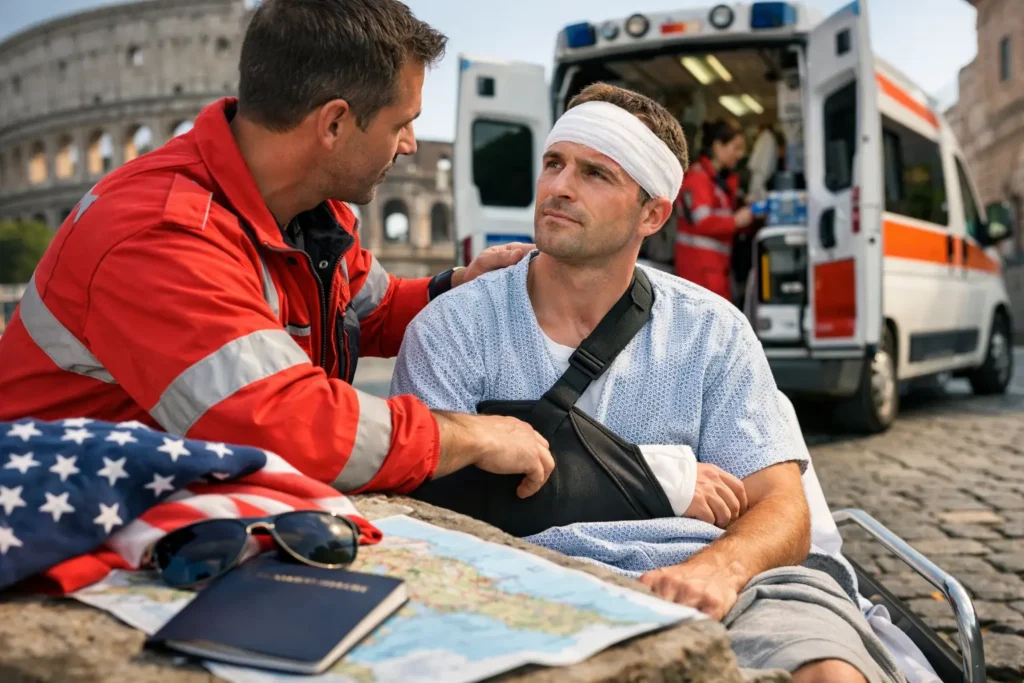
A vacation can change in a moment: a collision on a narrow street, a fall in a hotel stairwell, an injury at a work site, or negligent medical treatment. When a US citizen injured in Italy is facing pain, unfamiliar procedures, and a language barrier, the first priority is medical care. The next is protecting the legal position before evidence disappears, witnesses leave, or an insurer defines the story on its own terms.
Italian law can provide meaningful compensation after an accident, but the process is not identical to a claim in the United States. The right early steps can preserve your ability to recover medical costs, lost income, and damages for the personal impact of the injury.
Get medical care and create a clear record
Call 112 for emergency services in Italy. Depending on the circumstances, police, ambulance services, or other responders may attend the scene. Do not decline medical evaluation simply because you hope to continue traveling or believe the injury is minor. Adrenaline can mask symptoms, and a prompt medical record often becomes central evidence in a later claim.
Ask for copies of discharge papers, test results, prescriptions, invoices, and any written diagnosis. If the documents are in Italian, keep the originals. A qualified translation can be arranged later, but missing records are harder to replace.
If you can do so safely, take photographs of the location, the hazard, damaged property, visible injuries, and the vehicles involved. Note the time, exact address, weather, names of businesses, and contact information for witnesses. A short contemporaneous note in your phone may be more reliable than trying to reconstruct events weeks later from the United States.
Report the accident, but protect your words
For a traffic collision, request that the police document the incident. In a hotel, restaurant, shop, rental property, or other premises, report the injury to the manager and ask for a written incident report. At work, report the injury through the employer’s formal procedure. Keep a copy of every report, email, or message.
Be accurate, calm, and factual. Do not speculate about fault, make a broad statement that you are “fine,” or sign a document you cannot read and fully understand. A polite conversation with an insurer, property manager, or opposing driver can later be treated as evidence. If translation is needed, ask for it.
This does not mean refusing necessary cooperation. It means understanding that an early statement can affect a high-stakes claim. A lawyer can help ensure the facts are presented clearly and that no one pressures you into an incomplete account or a premature settlement.
A US citizen injured in Italy may have more than one claim
The available legal path depends on how the injury occurred. A road accident may involve the driver, vehicle owner, and motor liability insurer. A fall on poorly maintained property may create a claim against the owner, occupier, operator, or another party responsible for the dangerous condition. Injuries caused by defective products, unsafe excursions, construction activity, or professional negligence require their own analysis.
Italian compensation law generally recognizes both economic and non-economic harm. Recoverable losses may include treatment expenses, rehabilitation, travel required by treatment, lost earnings, reduced earning capacity, and the physical and psychological consequences of the injury. In serious cases, long-term disability, scarring, loss of independence, and the effect on family life may require careful medical and legal evaluation.
The value of a claim is not determined by a single bill or an insurer’s first offer. It depends on medical evidence, the degree of fault, the severity and permanence of the injury, and the documented impact on the injured person’s life. An injury that initially appears manageable can become more significant when symptoms persist or interfere with work.
Do not assume travel insurance will solve everything
Travel insurance can be useful for immediate expenses, medical evacuation, trip interruption, or emergency assistance. It is not necessarily a substitute for a personal injury claim against the party responsible for the accident. Likewise, health insurance may pay for treatment without resolving who is legally liable for the underlying harm.
Insurance companies often ask for records, statements, authorizations, and medical information quickly. Provide what is genuinely required, but be cautious with broad releases that may give an insurer unrestricted access to unrelated medical history. Before accepting payment labeled as a final settlement, understand exactly which rights you may be giving up.
There can also be reimbursement issues. A health insurer, travel insurer, or benefits provider may seek repayment from compensation recovered from a responsible party. These questions should be addressed as part of the legal strategy, not discovered after a settlement has already been accepted.
Criminal and civil proceedings can overlap
Some accidents in Italy, particularly serious traffic crashes, workplace incidents, or injuries caused by reckless conduct, may lead to a police investigation or criminal proceeding. That process can produce important evidence, including official reports, witness statements, photographs, and expert findings.
A criminal case and a civil compensation claim are related but distinct. The existence of an investigation does not guarantee compensation, and the absence of criminal charges does not automatically eliminate a civil claim. The best approach depends on the facts, the evidence available, and the procedural stage of the matter.
For an injured American, this is where coordinated representation matters. The goal is to protect your right to information, preserve evidence, and pursue compensation without allowing unfamiliar procedure or language barriers to weaken your position.
Timing matters, even after you return home
You do not need to remain in Italy indefinitely to protect your rights. Much of the legal work can be handled through a properly authorized Italian lawyer, with secure communication and carefully organized records. Still, delay is risky. Surveillance footage may be overwritten, vehicle damage may be repaired, witnesses may become difficult to locate, and documents can be lost.
Deadlines also vary according to the type of claim, the parties involved, insurance rules, and whether criminal proceedings are pending. Do not rely on a general assumption that you have years to decide. A lawyer should review the facts promptly and identify the applicable notice requirements and limitation periods.
Your return to the United States creates practical issues as well. Continue treatment as medically appropriate, retain all US medical records and receipts, and tell your treating providers how the injury affects your daily activities and ability to work. Those records may help show the full consequences of an accident that occurred abroad.
What the US Embassy can and cannot do
The US Embassy or a US consulate may assist with practical information, communication with family, replacement documents, and lists of local resources. In some circumstances, consular staff may help you understand how to contact local authorities or obtain information about emergency services.
However, consular officials cannot act as your personal injury lawyer, investigate liability on your behalf, negotiate with insurers, or represent you in an Italian court. Legal representation requires an attorney who understands the Italian system and can act directly to defend your interests.
Get legal guidance before the facts become harder to prove
After an injury abroad, the pressure to move on is understandable. You may be trying to get home, resume work, care for your family, or avoid reliving a traumatic event. But a quick settlement, an incomplete report, or a missed deadline can leave you carrying costs that should belong to the responsible party.
Avvocati.Us provides individualized legal support for international clients dealing with accidents and high-consequence disputes in Italy. A case assessment can clarify what evidence should be secured, who may be responsible, and what compensation path is available under Italian law.
Your injury should not become more difficult to address simply because it happened far from home. Get medical care, preserve the facts, keep your records, and seek legal advice early enough to protect the choices that remain yours.
