
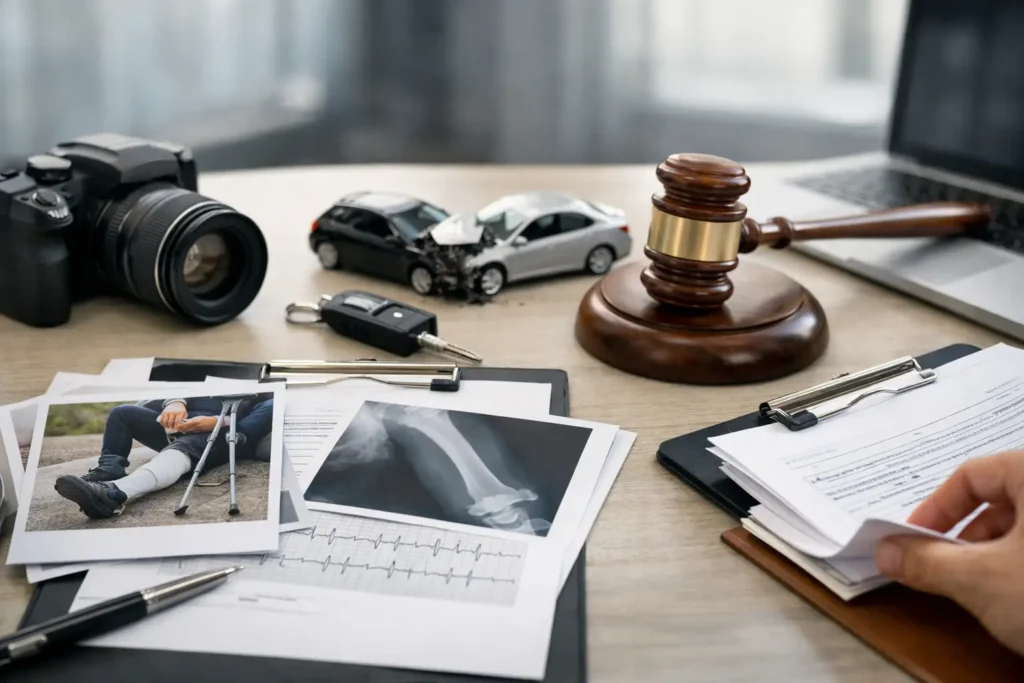
After an accident, the strongest case usually belongs to the person who can prove what happened, how badly they were hurt, and what that injury has cost them. That is why the best evidence for injury claims is rarely just one document or one photo. It is a clear chain of proof that connects the event, the injury, the treatment, and the financial and personal damage that followed.
Many people assume the truth will speak for itself. In legal claims, it usually does not. Insurance companies, opposing counsel, and defense experts look for gaps, delays, inconsistencies, and anything else they can use to reduce payment or deny responsibility. Good evidence closes those gaps before they become problems.
What counts as the best evidence for injury claims?
The best evidence for injury claims is evidence that does three things at once. It shows liability, it confirms the injury, and it documents losses in a way that can be verified. A claim becomes stronger when those three pieces support each other.
A hospital record may show you were injured, but it may not explain exactly how the accident happened. A witness may explain what happened, but not the full extent of your pain or lost income. A paycheck stub may prove missed work, but not the medical reason for those missed days. The most persuasive claims are built by combining evidence from several sources so the story is consistent and hard to challenge.
Medical records usually carry the most weight
If there is one category of evidence that shapes the value of most injury claims, it is medical documentation. Emergency room records, ambulance reports, imaging results, specialist evaluations, physical therapy notes, prescriptions, and follow-up visits all help establish that the injury is real and required treatment.
Timing matters here. If you wait too long to seek treatment, the defense may argue that your injury was minor or unrelated to the accident. If your records show early complaints that match the mechanism of injury, your position is much stronger. A back injury reported on the same day as a rear-end collision is easier to defend than one first mentioned weeks later.
Consistency matters just as much. If you tell one doctor your neck hurts, another your shoulder hurts, and a third that you feel fine, those inconsistencies may be used against you. That does not mean every record must sound identical. It means your symptoms, limitations, and course of treatment should make sense over time.
Photos and video can settle disputes quickly
Visual evidence often changes the tone of a case. Photos of the accident scene, visible injuries, property damage, road conditions, broken flooring, defective equipment, or safety hazards can preserve details that disappear within hours.
Video can be even stronger. Surveillance footage, dashcam recordings, traffic camera clips, or phone video may show the impact itself or the dangerous condition that caused it. In some claims, this is the difference between a disputed case and a clear one.
Still, visual evidence has limits. A photo of vehicle damage does not automatically prove the severity of a physical injury. Some serious injuries, especially soft tissue injuries, concussions, and internal trauma, may not be obvious from images taken at the scene. That is why photos work best when they support medical and witness evidence rather than replace it.
Witness statements help prove what happened
Independent witnesses can be extremely valuable because they have less personal stake in the outcome. A neutral observer who saw a driver run a red light or saw a business ignore a spill before a fall can support liability in a way that is difficult to dismiss.
The best witness statements are obtained early, while memory is still fresh. Over time, details fade, contact information is lost, and people become harder to locate. Even when a witness is willing to help, a vague statement months later is less persuasive than a prompt, detailed account.
There is also a difference between eyewitnesses and supporting witnesses. Eyewitnesses describe the event. Supporting witnesses may not have seen the accident but can speak to the changes in your daily life, physical limitations, pain, sleep disruption, or inability to work. Both can matter, especially when the defense tries to minimize the impact of the injury.
Incident reports and official records matter more than people realize
Police reports, workplace injury reports, store incident reports, OSHA records, and similar documents can help establish the basic facts. They may identify the parties involved, note visible injuries, record initial statements, and confirm the time and location of the event.
These records are not always perfect. Sometimes they contain mistakes, incomplete observations, or one-sided explanations. Even so, they often become a starting point for insurers and attorneys. If an official record supports your account, that is helpful. If it contains errors, those should be addressed early rather than ignored.
Your own documentation can strengthen the claim
A personal injury journal may sound minor compared with hospital records, but it can be powerful when used properly. Daily notes about pain levels, mobility problems, missed events, sleep issues, emotional stress, medication side effects, and treatment progress can show how the injury affected real life outside the clinic.
This is especially important for damages that are harder to measure. Pain and suffering are real, but they are easier to challenge when there is no record of how the injury disrupted your routine. A simple, honest, consistent journal can make those losses more concrete.
Save practical evidence too. Keep receipts, invoices, pharmacy costs, mileage to appointments, medical equipment purchases, and home care expenses. If the injury affected your work, keep emails, attendance records, disability paperwork, and wage statements. Strong claims are not built on memory alone.
Employment and financial records prove economic loss
If an injury caused missed work, reduced hours, missed business opportunities, or long-term earning limits, financial records become essential. Pay stubs, tax returns, employer letters, contracts, invoices, and accountant statements may all help show what the injury has cost you.
For self-employed people, this part is often more complicated. Income can fluctuate, and losses are not always obvious from a single month. In those cases, a careful review of prior earnings, canceled projects, reduced capacity, and business records may be needed to show the real financial impact.
This is one of the areas where weak documentation can cost a claimant far more than expected. If the numbers are not supported, insurers often discount them aggressively.
Social media can help or hurt
People are often warned not to post after an accident, and that advice is sound. A casual photo, joke, or comment can be taken out of context and used to argue that the injury is exaggerated. Even harmless posts may create questions that distract from the core facts.
At the same time, existing digital evidence can sometimes help. Time-stamped communications, messages about the accident, calendar changes, or photos shared privately with family may support your timeline. The key is not to curate a story online. It is to avoid creating avoidable damage while preserving what already exists.
The biggest mistakes that weaken good claims
The most common evidence problems are preventable. Delayed treatment, missing follow-ups, inconsistent statements, lost photos, incomplete records, and informal cash expenses with no receipts all create openings for the other side.
Another mistake is assuming minor cases do not need careful proof. Some claims look simple at first and become contested later, especially when symptoms last longer than expected or fault is disputed. Evidence gathered early is almost always better than evidence reconstructed later.
There is also a judgment call about what not to include. More evidence is not always better if it is repetitive, contradictory, or irrelevant. The goal is not to overwhelm. It is to present a credible, organized case that supports every major point.
Building evidence early gives you leverage
A strong injury claim is not just about proving that you were hurt. It is about proving enough, early enough, and clearly enough that the other side understands you are prepared to defend your rights. That often changes settlement discussions long before trial becomes necessary.
For people dealing with serious injuries, cross-border issues, or a disputed version of events, legal guidance can make the difference between a claim that drifts and one that is built with purpose. Firms such as Avvocati.Us approach these cases with that goal in mind – protect the client, preserve the evidence, and push for the maximum benefit the facts support.
If you are asking what evidence matters most, you are already asking the right question. The next step is acting before records disappear, memories fade, and the other side gets too far ahead of the facts.
